Model 1115 - 1:1 Current Balun, 1-31 MHz, 3kW
- SKU:
- 1115
- Shipping:
- Calculated at Checkout





Description
Balun Designs, in collaboration with Fair Rite products, has developed what we consider to be one of the best single core 1:1 feedline isolation baluns available today. By reviewing the scans shown below you can see what we're referring to. Notice how the level of choking impedance ramps up very quickly developing 3100 ohms on 160m and continues at high levels across the full HF spectrum. This is a difficult to achieve and maintain for a single core balun and comes with near perfect transformation, SWR and return loss.
Mounting options are available in "Accessories & Connectors" category
This balun is more than just high power. Tests show SWR is below 1.04 across the entire HF band, transformation is perfectly flat, return loss is typically 65-85 dbmw. Please click on the graphs shown below to view the complete test results.
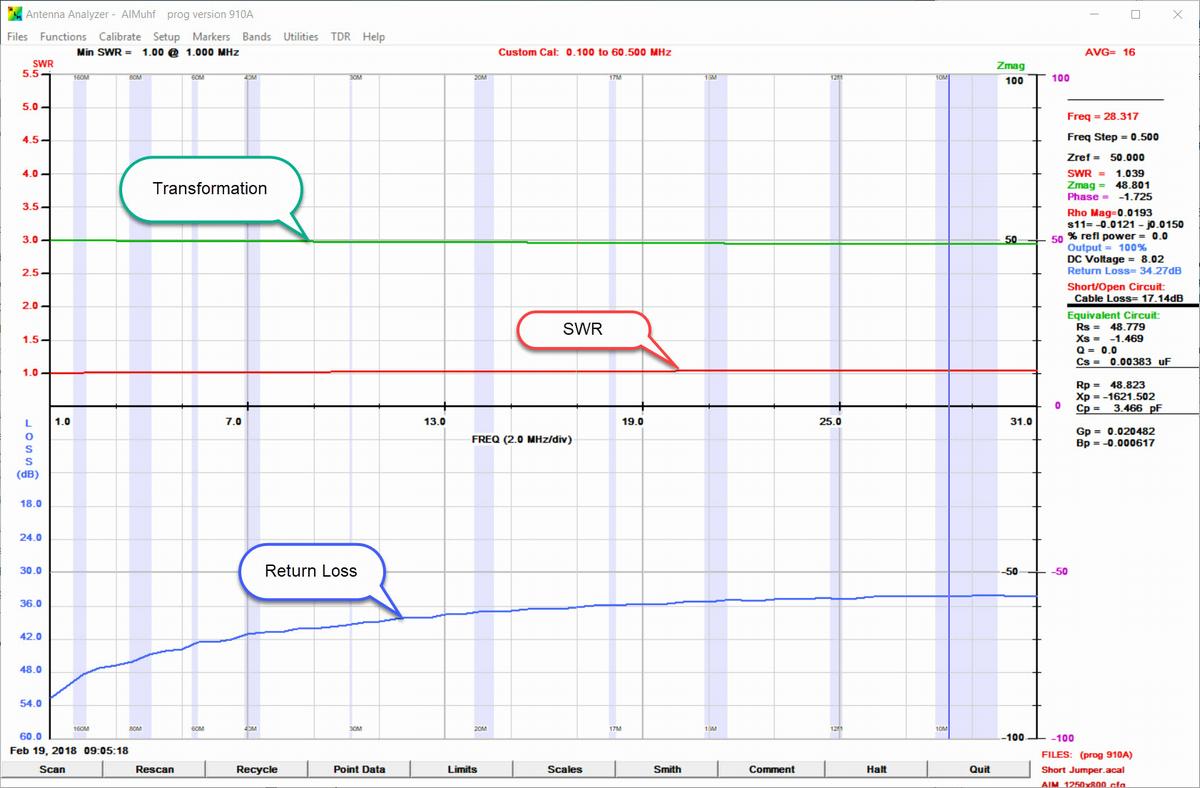
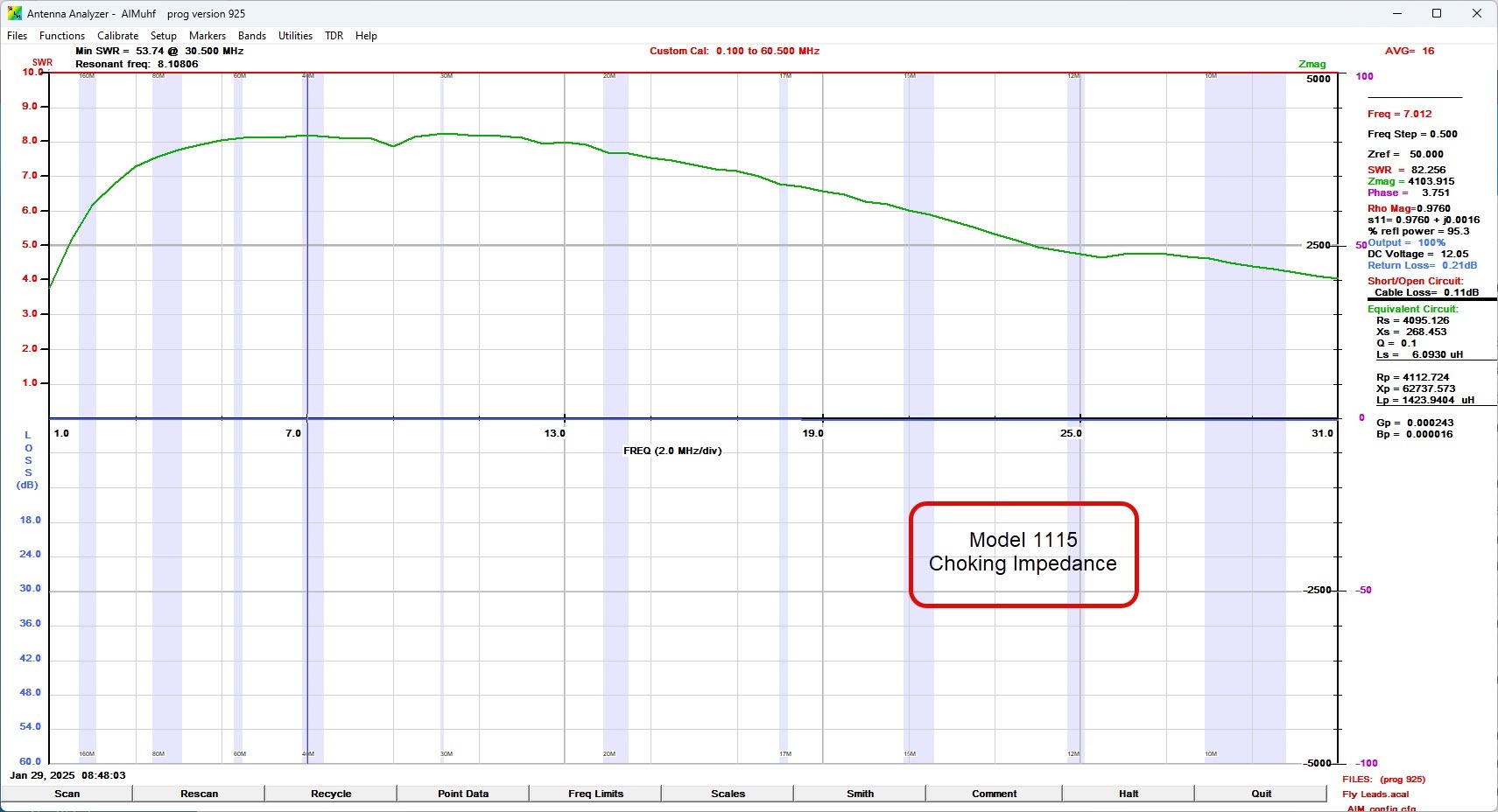
Tests completed utilizing AIM-4170c Network Analyzer and precision 50 ohm non inductive load.
Hello Bob,
I want to share how happy I am with the new 1115i balun I purchased from you recently. I was able to complete some antenna repairs last weekend and finally attached the 1115i balun to my inverted V fan dipole. I clearly hear more stations now than I have in at least a year ! The noise floor for me is lower now than it ever has been. Another bonus, I can now happily run my ALS-600 with no problems.
Can't wait to install the other 1115t balun I purchased to my A3S.
Thank you for another great product !!
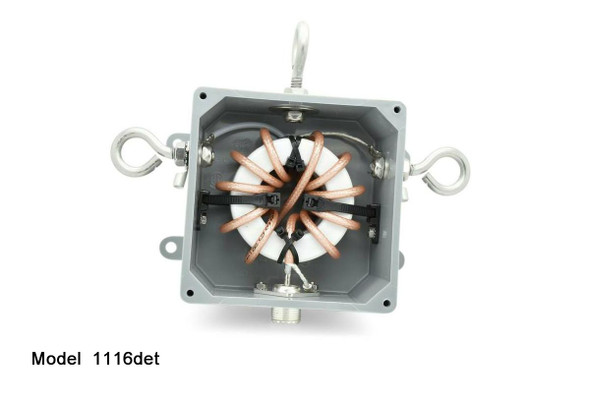
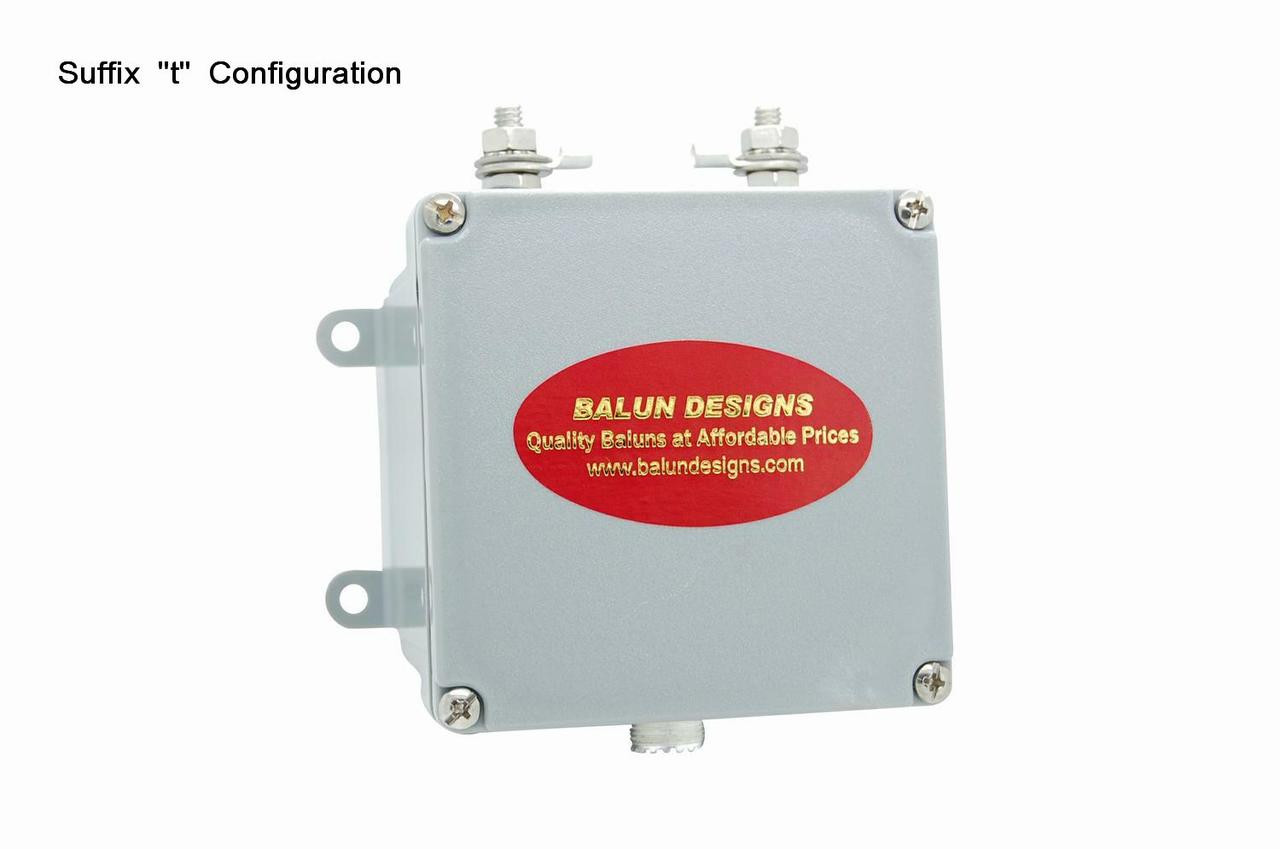
Windings of Mil Spec coax allow this balun to provide a very high power rating across all HF frequencies while also providing a uniform impedance, excellent transformation and high levels of RF choking / feedline isolation. By utilizing one of our mounts in Accessories, the balun can be securely installed on a mast, boom or where ever you need it.
Sometimes called a choke balun or common mode choke, this 1:1 ratio current balun is the best for feedline isolation. It has the widest operating frequency range, lowest core stress and provides the best overall balance of any balun for given cost, size, and weight. If you have a yagi you should be using one to balance the power to the driven elements and prevent the coax feedline from distorting your radiated pattern. If you have a vertical you should be using one to prevent the vertical element from using your coax as a radial and to decouple the feedline for reduced noise.
Tests carried out in an anechoic chamber to determine the affects of imbalance on radiation patterns of a half wave dipole (published April, 1980 in QST) show just how serious this can be and how important the function of the balun is in achieving predictable patterns. Notice how the pattern is distorted when the feedline is not being isolated with a balun.
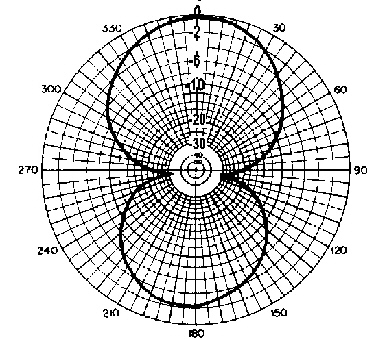
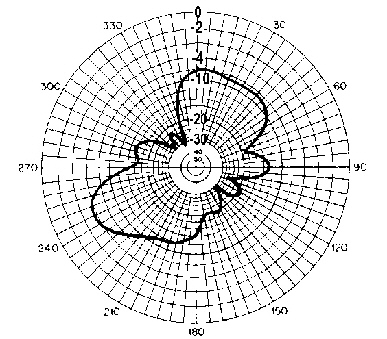
Click to Enlarge
Regardless of the antenna you're using, an isolation balun can provide numerous advantages
- Prevents unwanted RFI by eliminating feedline common mode currents and radiation
- All power goes to the antenna, improving efficiency
- Reduces noise or EMI picked-up by your coax shield
- Power is balanced between driven elements of antenna
- Can help overcome a less than optimal ground
***ONE EXCEPTION!***
It must be pointed out that a 1:1 balun should never be used on the second harmonic of a half-wave center-fed dipole fed with coax (like an 80 meter dipole being used on 40 meters). The impedance can be as great as 5,000 ohms creating very high voltages which can bring about voltage breakdown and/or excessive heating. This exception ONLY applies to Coax Fed HALF WAVE CENTER FED DIPOLES WHEN USING A 1:1 BALUN AT THE FEEDPOINT. This caution does not apply to fan dipoles or any dipole that utilizes loading coils to create resonance on the bands in use.
Specifications
| Core Material | Custom mix ferrite by Fair Rite Products for maximum bandwidth. Large 2.4 inch core is coated and sealed for long term durability. |
| Winding Type | Single core, coaxial wound 1:1 current balun |
| Winding Material | Mil Spec 50 ohm coax rated 19kW @ 1MHz, 9kW @ 10 Mhz and 5kW @30MHz. Silver flashed braid and center conductor with solid Teflon dielectric. |
| Power Rating | 1 to 35 MHz - 3kW continuous - Baluns, Ununs and Power Ratings All ratings measured with resonant 50 ohm load. |
| Useable Frequency | 1 to 54 MHz |
| Insertion Loss | Less than 0.1db |
| Connectors | SO-239 connectors are gold center conductor with Teflon insulation. Studs and eyebolts are 1/4 inch. Alternate connectors and Mounting Options are available in the Accessories section. |
| Hardware | All Stainless Steel |
| Enclosure Type | NEMA rated 4x marine grade junction box for outdoor installations. Cover has neoprene gasket for weatherproof integrity. |
| Dimensions | 4x4x2 inches for main body of unit Dimensional Drawing of Standard Enclosure |
| Additional Info | Very high efficiency. Will not heat up or saturate at like many of the "less expensive" designs. |

Warranty Information
Noise Reduction
It is a seldom appreciated fact that feedlines which are not adequately decoupled can act as efficient vertical antennas that degrade an otherwise excellent radiation pattern. The addition of a quality feedline isolation ("choke") balun can significantly reduce feedline radiation and dramatically decrease RFI and TVI. It does this by providing the antenna with balanced current at the feedpoint and by effectively preventing the coax shield from acting as part of the antenna.
While the most common advice is to improve the station's RF ground, the root of the problem is in the poor isolation of the feedline from antenna currents. If your goal is to reduce feedline radiation and improve reception by reducing noise, feedline isolation baluns are an excellent choice. Adding an additonal isolation balun at the point where the feedline exits the near field area of the antenna will substantially reduce unwanted feedline radiation and reception of EMI without the need for improved station grounding.
If your antenna SWR is already low and you wish to reduce feedline radiation and improve reception, a feedline isolation balun is recommended. Adding one at the base of a vertical antenna will substantially reduce unwanted feedline radiation (RFI) by preventing your antenna from using the your coax feedline as a radial. This can also reduce the need for improved station grounding.
Benefits to Vertical Antennas
When quarter-wave antennas are constructed over a near perfect radial system, they have a feedpoint impedance of about 36 ohms. When they are constructed over a less than optimal radial-system there is a loss introduced into the feed system that adds to the 36-ohm figure. This improves the SWR but there is a loss in the efficiency of the antenna, signals transmitted and received have a higher take-off angle and often there is current introduced onto the feedline.
With my SteppIR vertical I use two of these baluns. One at the base of the antenna and another midway along the feedline after the near field of the antenna. You can also install the balun where it enters your shack if you would rather not break the feedline run. The balun balances the RF currents at the antenna, is terrific for keeping RF out of your operating environment and greatly reduces the noise inherent in a vertical by decoupling the feedline.
With a ground-mounted quarter-wave vertical, regardless of the radial situation, but especially with poor radial systems, there is the need for a feedline isolation balun to keep common mode currents off the feedline.
Benefits to Yagis
Yagi antennas especially, benefit from improved balanced drive and superior feedline isolation, but even simple dipoles benefit from properly selected and installed Feedline Isolation baluns. In addition, receiver noise may also be reduced by eliminating stray EMI picked up by the coax shield.
Another very useful application for a feedline isolator is installing them in series with a yagi antenna’s normal feed system. The proper location is between the antenna’s matching device/system and the feedline. Doing this will not affect the antenna and prevents the feedline from acting as part of the antenna. In beam installations, using a feedline isolator in series with the antenna’s feed system can substantially improve the antenna’s front-to-back and front-to-side ratios.
Related Products
Related Products

Model 1115d - Isolation/ Choking 1:1 Balun, 3-54 MHz, 5kW


Model 1113 - 1:1 Current Balun 7-54 MHz 3kW

Model 1171 - 1:1 ATU Current Balun, 1 - 35 MHz, 5kW