
Model 1171 - 1:1 ATU Current Balun, 1 - 35 MHz, 5kW
- SKU:
- 1171
- Shipping:
- Calculated at Checkout




Description
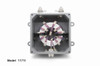
This is a departure from the normal 1:1 isolation/choke balun and utilizes a bifilar pair designed to handle the high voltages typically found on multiband antennas such as doublets and multiband loops. The balun functions to transform balanced twin lead, ladder line or open wire to unbalanced coaxial feedline while providing high levels of choking impedance to stop common mode currents from entering equipment. In this application any small impedance transformation caused by the current balun is immaterial because the tuner will compensate, so the windings do not need to be of any specific characteristic impedance. Bifilar windings using Thermaleze wire inserted in Teflon tubes are employed to cope with the high differential-mode voltages present at current minima.
This balun is also excellent for use installed between a remote auto tuner and multiband antenna to suppress common mode allowing a cleaner more accurate match.
With wire antennas being used primarily on the lower HF bands, choking impedance for this balun has been shifted to provide maximum performance on the 160m through 40m bands. However, this ferrite mix also provides excellent common mode control on the upper HF bands where high choking impedance levels are not as critical. It is best installed outdoors to minimize the chance of RF entering the operating position from the balanced feedline.
Typically this balun is utilized with a tuner that can easily match a wide set of impedance values. If you have a tuner with limited range, consider using one of our 4:1 baluns to reduce the required impedance match and thereby assist the tuner. Click on the graph below to view the full choking impedance curve.
Power ratings for all baluns degrade as SWR increases. Typically a balun loses 40% of its power rating at 2:1 SWR and 60-70% at 3:1. The SWR for most bands on the antennas mentioned above will typically be at or above 2:1 when using a 1:1 balun. Consequently the power rating of this unit should be used as a baseline for calculations using your actual SWR as measured where the balun is installed.
IMPORTANT: This balun is NOT wound with the normal 50 ohm pair, rather the design criteria is maximizing inter-conductor breakdown voltage which results in a 97 ohm pair. Consequently, this balun is intended primarily for use with multiband wire antennas such as doublets and loops where there will be a wide range of impedance values generated across multiple bands and with a tuner required for the final match. Use with coaxial fed resonant antennas of any type is NOT recommended.
Cores utilized in this model are optimized for lower HF frequencies. See the model 1161 for cores optimized at mid to upper HF bands.
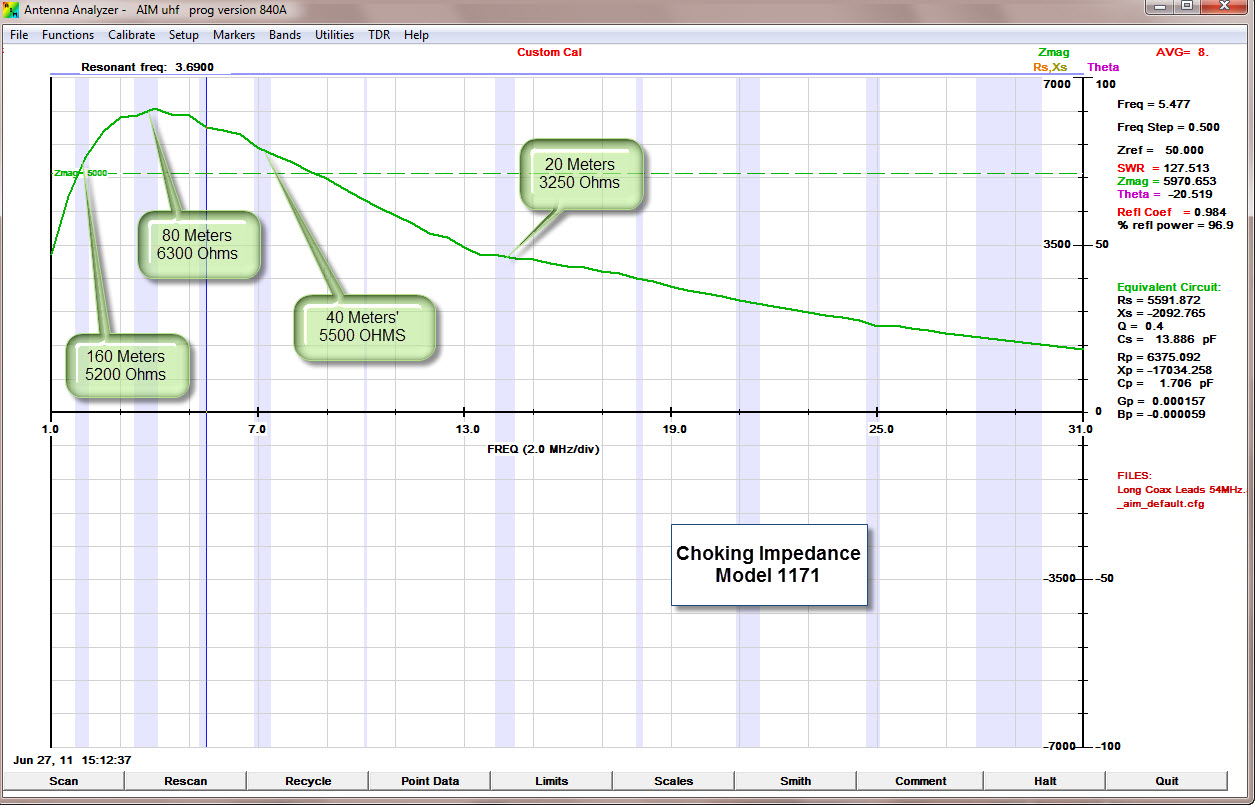
Click to Enlarge
Testing done with an AIM-4170uhf Network Analyzer
Mounting options are available in "Accessories & Connectors" category
Design Criteria
- T match antenna tuners perform quite poorly if the resistive component of load impedance is very low, even worse if there is also a high capacitive reactive component. This is a common load found in shortened dipoles fed with open wire line.
- The traditional approach is to use a 4:1 balun on such antennas, but antenna tuner loss is worse with low resistive loads.
- The need to tolerate high voltages occurs when the balun happens to be located near a differential voltage maximum.
- Ability to generate high choking impedance for effective reduction of common mode current.
- Balun is intended for use with an antenna tuner which will manage SWR and transformation mismatches.
- Differential insertion loss is not significant in this application, the dissipation in a current balun is primarily from the common mode current which is installation dependent and not easily predicted
In this application any small impedance transformation caused by the Current Balun is immaterial because the tuner will compensate, so the windings do not need to be of any specific characteristic impedance. Bifilar windings using Thermaleze wire inserted in Teflon tubes are employed to cope with the high differential-mode voltages present at current minima.
Specifications
| Core Material | Custom mix ferrite from Fair Rite Products optimized for low frequencies. Two Large 2.4 inch cores are coated and sealed for long term durability. |
| Winding Type | Bifilar pair 1:1 current balun at 97 ohms, Stacked dual core provides larger effective core. |
| Winding Material | Heavy gauge Essex polyamideimide Allex 240 Winding Wire wire inserted in teflon tubes. Breakdown voltage in excess of 10kv |
| Power Rating | 1 to 31 MHz - 5kW in to resonant load. |
| Useable Frequency | 1 to 54 MHz |
| Insertion Loss | Less than 0.1db |
| Connectors | SO-239 connectors are gold center conductor with Teflon insulation. Studs and eyebolts are 1/4 inch. Alternate connectors and Mounting Options are available in the Accessories section. |
| Hardware | All Stainless Steel |
| Enclosure Type |
NEMA rated 4x marine grade junction box for outdoor installations. Cover utilizes integral neoprene gasket for weatherproof integrity. |
| Dimensions | 4x4x2 inches for main body of unit Dimensional Drawing of Standard Enclosure |
| Additional Info | Very high efficiency. Will not saturate like many of the "less expensive" designs. |
